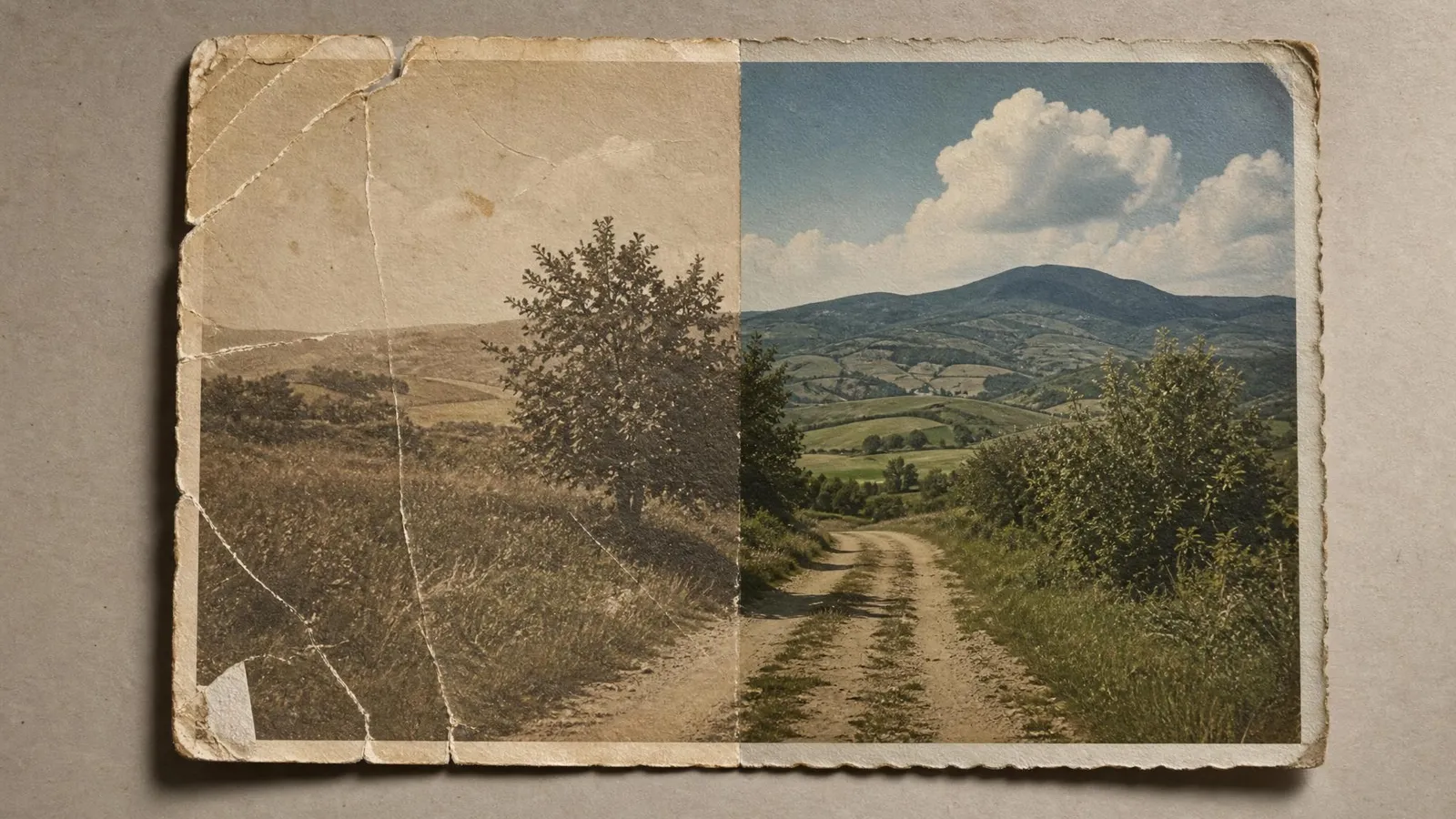
There is one question that matters when you hand an old family photo to a piece of software, and it isn’t “how sharp will it be”. It’s: will it still be her?
The failure mode is specific and it is common. A tool takes a soft, damaged face, and instead of repairing the pixels that are there, it generates a new face - plausible, symmetrical, younger, better skin, and not your grandmother. The output is technically impressive and emotionally worthless. Worse, it’s convincing enough that the family may not notice for years.
So here is the boundary we draw, as precisely as we can draw it.
What gets repaired
The damage layer. Scratches, tears, creases, dust, foxing spots, mould, water stains, tape shadows, and the pale grid of album-corner marks. This is straightforward: the information is still in the surrounding pixels, and removing damage is inpainting from real context.
Fading and colour casts. Contrast comes back, yellowed whites go neutral again, and a sepia print keeps its sepia character rather than being bleached into a modern black-and-white. Tone is a property of the print, and the restoration treats it as something to correct, not to replace.
Softness. Detail is recovered to a natural sharpness - hair, fabric weave, background texture. There is a ceiling here, and we’d rather stop below it than cross into the over-processed look where everyone’s skin turns to plastic.
Missing pieces. A torn-off corner, a chunk of sky, a chewed border gets reconstructed from what surrounds it and from what the period plausibly contained. This is the one repair category that is genuinely invention, and it’s confined to areas where nothing was left to preserve.
What is locked
Identity. Facial structure, features, apparent age, expression, hairstyle, posture, build. All of it pinned to the reference. The prompt architecture spends more words on this single constraint than on anything else, because it’s the constraint everything else is worthless without. No de-aging, no smoothing away a lifetime of expression lines, no “improving” a crooked smile.
Composition and framing. Same crop, same people, same arrangement, same distances. Nobody gets added to the photo, and - this matters - nobody gets removed from it either.
The era. Clothing, haircuts, furniture, cars, signage, the make of the pram. A restoration that quietly modernises a detail has stopped being a restoration and become a period drama.
Inscriptions. Handwritten notes on the front, studio stamps, dates, the photographer’s embossing. These are preserved as they are - never retyped, never restyled, never invented. Model-generated lettering is the single fastest way to spot a fake, and in a family archive the caption is often the most valuable data in the frame.
The test you can run on any tool
Take a photo where you knew the person well. Restore it. Then crop out everything except the face, at full zoom, and show it to someone else who knew them - without the rest of the photo for context.
If they say “yes, that’s him”, the tool repaired. If they hesitate, or say “sort of”, the tool generated. Faces are the one thing humans audit at superhuman accuracy, which makes them the perfect test and the worst possible thing to get wrong.
Colorization is an interpretation, not a record
This deserves its own paragraph, because it’s where honest tools and marketing part company.
When a black-and-white photo is colorized, some of the colour is close to certain: skin, sky, grass, wood, brick, the general behaviour of light. Some of it is a reasonable inference from the era and the material: what a 1950s bus in that city probably looked like, what that fabric probably was.
And some of it is a guess. Nobody - no model, no colourist, no historian - can recover the colour of a specific dress from a monochrome negative. The information is not in the file. A colorized photo is a plausible reconstruction, and the right way to describe it to family, or to attach it to a genealogy record, is exactly that.
If you know the real colours, say so and order a couple of versions to pick from. If you’re contributing to an archive, keep the monochrome original as the record and label the colour version as an interpretation. We’d rather say this out loud than let a colourised photo quietly become someone’s evidence.
Keep the original
A restoration is a repaired copy. It is not a replacement for the artifact, and the artifact holds things the copy doesn’t - paper stock, the studio’s embossing, whatever is written on the back, the fact that someone carried it in a wallet for forty years.
Photograph it (here’s how), restore the copy, put the print back in the box.
Why these two niches are our only exception
Everywhere else on Phoxel, people stay out of the result. A person in a reference photo is removed, and every generation prompt explicitly blocks human faces and bodies from appearing in the output - because a pet portrait, a product shot or a staged room has no legitimate reason to contain an invented human.
Restoration and colorization are the deliberate exception, and the reason is the whole point of this post: here the people in the photo are the subject, and they are real people who were already there. Nothing is invented. A face is repaired or coloured; it is never conjured.
That’s a narrower promise than “AI can bring your photos to life”, and we’ll take the narrower one.