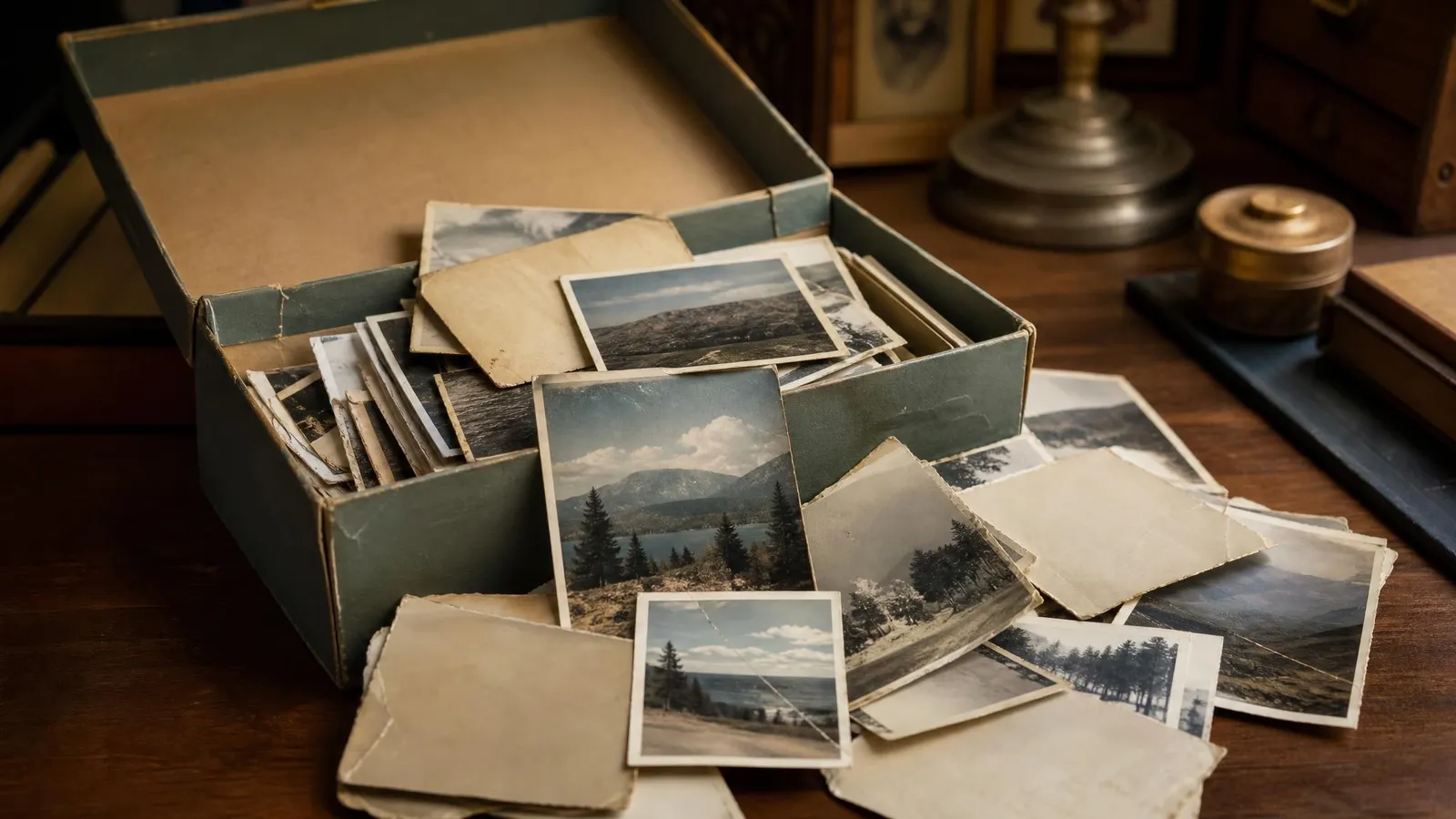
Somebody in your family has a box. Two hundred prints, maybe four hundred, going back to the 1930s, and a third of them are fading, creased or stuck to the album page. Everyone agrees something should be done. Nothing gets done, and the reason is almost always the price of photo one.
Here is the arithmetic, done in the open. Figures are typical advertised rates as of mid-2026 - your market will vary, the shape of the math won’t.
The five ways to restore an old photo
A restoration studio. Typical advertised pricing runs roughly $25–$120 per photo, with heavily damaged work quoted higher - a few studios list up to $300 for the difficult ones. That sounds steep until you see the labour behind it: a skilled retoucher spends somewhere between one and six hours per photo in Photoshop, cloning, patching and rebuilding by hand. At that rate the price isn’t a markup, it’s a wage. What you get for it is judgement - someone deciding what the missing corner should contain, and being accountable for the answer.
A freelance retoucher. Marketplace freelancers commonly work in the $15–$30 per photo band. Same manual craft, less overhead, more variance in outcome. Good for a handful of photos where you can review each one and re-brief.
Hand colourisation. Its own discipline and its own price: traditional hand-colouring of a black-and-white photo runs $100–$500+ per image, and studios offering a lighter-touch service start around $35. A colourist is researching period-correct dyes and uniform colours and painting them in on masks. It is slow, and when it’s done well it is genuinely beautiful.
AI tools. The current market sits somewhere around $0.13–$0.50 per photo, with plenty of services bundling several restorations into a few dollars. This is the tier that changed the question, and it’s worth being blunt: the price differences inside this tier are noise. What separates these tools is not cost, it’s whether the face that comes back is the face that went in.
DIY in Photoshop. The software costs what a subscription costs; the real spend is a skill that takes months to become useful and a weekend per difficult photo. Genuinely rewarding if restoration is a hobby you want. A trap if it’s a task you want finished, because the box does not get smaller while you learn.
Where Phoxel lands
Restoration and colorization both run at 10 credits per photo - $0.16 to $0.30 depending on the pack, the same credits that work in every other niche. A colorized version repairs the damage in the same pass, so it’s one job, not two.
The honest comparison isn’t “cheaper than a studio”, because a studio does something we don’t: a human looking at a photograph and making decisions about it. The comparison that holds is what happens to the number of photos you restore.
The number that actually matters
At $50 a photo, you restore three. You pick the wedding, the one of your grandfather in uniform, and one more, and the other three hundred and ninety-seven stay in the box, continuing to fade. That’s not a budget decision, it’s a triage decision, and everyone who has made it knows which photos they left behind.
At under thirty cents, triage stops. You do the whole box. You do the blurry ones and the boring ones - the street, the kitchen, the dog, the cousins nobody can name - and those turn out to be the photos people actually spend an hour looking at, because they’re the ones nobody has seen since 1974.
That’s the shift. Not “restoration got cheaper”, but “restoring everything became possible”, which is a different product.
The same logic applies to versions. When a second attempt costs another $50, you accept the first one. When it costs thirty cents, you order the faithful tone and the warm one, or three colour palettes, and you keep the one that looks like the room you remember.
When to hire a human anyway
Three cases, and we’d rather say them than pretend otherwise:
The photo that matters most. If there’s one image in the box that would devastate you to get subtly wrong, pay a person. Not because the automated result will be bad, but because for that one photo you want someone accountable for every decision.
Severe damage. Half a face missing, a print torn into pieces, mould that ate the emulsion. Reconstruction at that level is interpretation, and interpretation is what humans are for. A model will produce something confident and smooth over the fact that it guessed.
Archival work. If the photograph is going into a museum, a published history or a formal genealogy record, the treatment needs to be documented and defensible. That’s a conservator’s job, not a credit purchase.
For everything else - the two hundred ordinary prints of ordinary days that make up the actual archive - the math has changed, and the box no longer has to be a project you’ll get to eventually.
If you want the arithmetic on your own box rather than ours, the cost calculator prices a batch both ways - studio rate on one side, the cheapest credit-pack combination on the other, versions included.
Start with one photo and see what comes back.